
Why Confidence Disappears in Competition
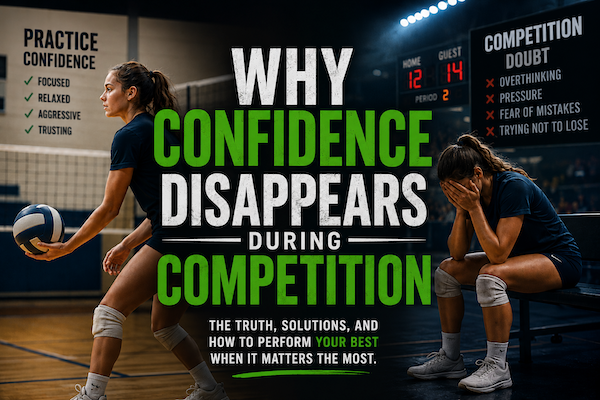
At SPMI, this is one of the most common challenges we see among athletes who are just entering our program. Athletes and parents often seek out our services because of a frustrating pattern: the athlete consistently underperforms in competition despite demonstrating a much higher level of performance in practice.
Parents will tell us, “I don't understand. I've seen what they're capable of. They look like a completely different athlete in practice.”
And they're often right.
In training, the athlete may look confident, aggressive, relaxed, and decisive. They take risks, trust their instincts, and recover quickly from mistakes. Then competition arrives, and suddenly everything changes. They hesitate. They overthink. They become afraid of making mistakes. Their body tightens, their decision making slows down, and the confidence that seemed so strong during the week appears to disappear.
This can be incredibly frustrating for athletes and parents because the physical ability is clearly there. They have already demonstrated it.
So what changes?
Usually, the athlete hasn't lost their ability. Competition has changed their focus, emotions, and perception of what is at stake.
Practice Feels Safe. Competition Feels Like Judgment.
Practice and competition can create very different psychological environments.
During practice, athletes generally have more freedom to experiment. Mistakes are expected. There is another repetition coming. The scoreboard may not matter. There may be less concern about disappointing a coach, parent, teammate, or themselves.
Competition changes that.
Now there is a score. There are consequences. People are watching. Playing time, rankings, scholarships, contracts, team selection, or simply personal pride may feel like they are on the line.
Instead of thinking, “How do I perform?” the athlete begins thinking, “What happens if I fail?”
That shift matters.
Confidence thrives when athletes are engaged in the task in front of them. It often deteriorates when they become preoccupied with evaluating themselves.
The Athlete Starts Trying to Protect Confidence
One of the great paradoxes of sport psychology is that athletes can become less confident because they are trying too hard to feel confident.
They tell themselves:
“I have to win today.”
“I can't make that mistake again.”
“I need to prove that I'm good.”
“What is my coach thinking?”
“My parents are going to be disappointed.”
Instead of competing freely, the athlete begins protecting themselves from failure.
They play not to lose.
A tennis player stops attacking and begins pushing the ball. A basketball player passes up an open shot. A quarterback holds onto the football too long. A golfer becomes consumed with swing mechanics. A gymnast focuses on avoiding a mistake instead of executing the routine.
The athlete's physical ability did not suddenly disappear.
Their attention moved from execution to evaluation.
Even the Best Athletes Experience It
Simone Biles provided one of the most visible examples of how pressure can affect even an extraordinary athlete.
During the Tokyo Olympics in 2021, Biles withdrew from several events after experiencing what gymnasts call the “twisties,” a dangerous loss of spatial awareness while performing complex skills.
This was an athlete who had already dominated at the highest level imaginable. Her previous success did not make her immune to pressure.
Her experience demonstrated an important lesson for young athletes: struggling under pressure does not mean you lack talent, toughness, or confidence. Elite athletes must manage their mental state just like everyone else.
The objective is not to eliminate pressure. It is to develop skills for performing effectively when pressure appears.
What Athletes Can Do
First, stop making confidence a requirement for competing well.
You do not need to feel amazing before you perform. You can feel nervous, uncertain, or uncomfortable and still compete effectively.
Instead of asking, “Do I feel confident?” ask, “What do I need to do right now?”
Second, develop process goals.
Choose two or three controllable actions before competition. These might include moving your feet, communicating with teammates, maintaining aggressive body language, committing to decisions, or resetting quickly after mistakes.
Third, create a reset routine.
Mistakes become especially damaging when athletes carry them into the next play. Develop a simple sequence such as taking a breath, using a cue word like “next,” adjusting your posture, and immediately identifying the next task.
Finally, collect evidence.
Confidence should not depend entirely on today's emotions. Keep track of successful practices, improvements, difficult situations you have overcome, and moments when you responded well under pressure.
Confidence becomes stronger when it is connected to evidence rather than feelings.
What Parents Can Do
Parents have tremendous influence over the emotional environment surrounding competition.
One of the most important things parents can do is separate performance from approval.
Your athlete should know that your relationship with them does not change because of a scoreboard.
After competition, resist immediately analyzing everything that went wrong. The car ride home does not need to become another coaching session.
Try asking, “What did you learn today?” or “What are you proud of?”
Parents should also praise behaviors that athletes control.
Instead of only celebrating wins, rankings, goals, points, or statistics, recognize preparation, courage, discipline, effort, communication, resilience, and willingness to compete aggressively.
Finally, be aware of your own emotions.
When parents appear devastated after a loss or overly excited after a victory, athletes may unintentionally learn that results determine everyone's emotional state. Remaining relatively consistent teaches the athlete that competition is important without making it feel like a judgment of their worth.
Confidence Is Not the Absence of Doubt
True confidence is not walking into every competition believing you are guaranteed to succeed.
It is trusting yourself enough to compete even when success is uncertain.
Athletes will experience nervousness. They will doubt themselves. They will make mistakes. They will have competitions where they simply do not feel confident.
The goal of mental training is not to prevent those moments.
It is to teach athletes that they can still perform when those moments arrive.
When athletes stop chasing the feeling of confidence and start focusing on controllable actions, something interesting often happens.
The confidence they were searching for begins to return.
Want to Help Your Athlete Build More Confidence?
If your athlete struggles with confidence, performance anxiety, overthinking, or performing differently in competition than they do in practice, mental training can help.
At SPMI (Sport Psychology Movement Institute), we work with athletes to develop practical mental skills that help them compete with greater confidence, focus, emotional control, and resilience under pressure.
Schedule a FREE 15-minute consultation with SPMI to learn more about our one-on-one mental training programs and how we can help your athlete strengthen the mental side of their performance.
Visit SPMIPLUS.COM to schedule your free consultation today.